Studio of One · Part 5
The Firsts: Six Gates Between an Idea and a Real Business
First Idea, First Build, First User, First Dollar, First $1K, First $10K. Why Make First ends every stage at a First with evidence, and what each gate tests.
Josh McWilliam
7 min read
- make-first
- teens
- studio-of-one
- freedom
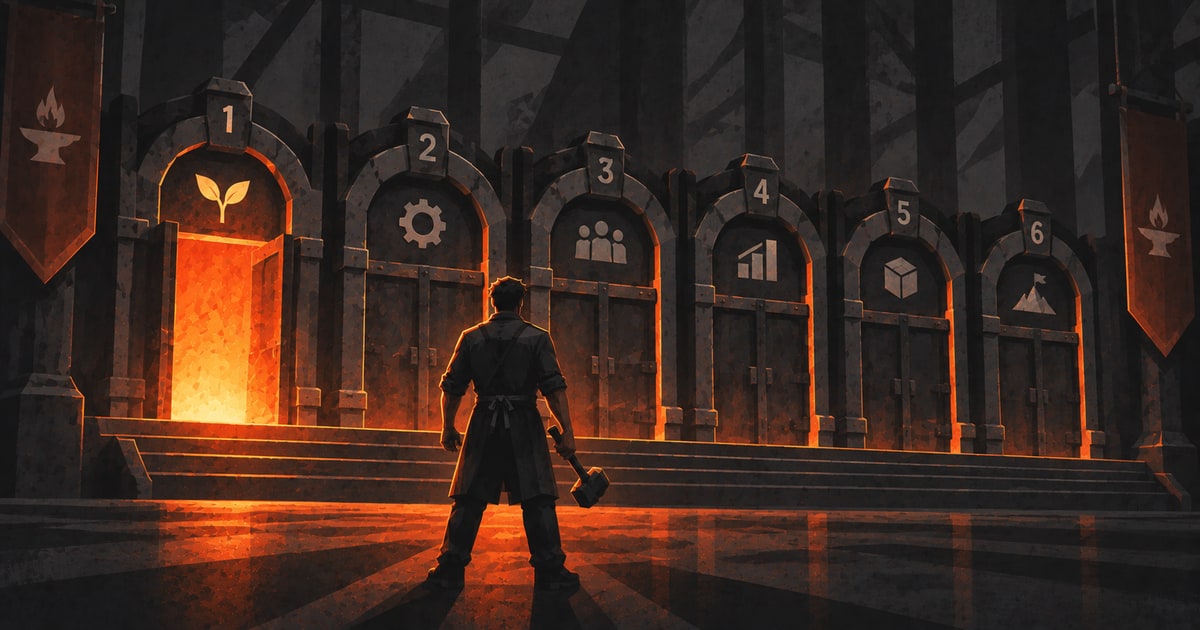
A First is a gate with evidence, not a feeling.
That’s the whole design of Make First in one sentence. Six stages in a semester, and each one ends at a First: First Idea, First Build, First User, First Dollar, First $1K, First $10K. You don’t pass a stage by working hard or by feeling ready. You pass it by producing something a stranger could check: a URL, a name, a payment record.
I built the gates for teenagers. They turn out to be the same gates for everyone. Here’s what each one tests, and why it’s in that order.
Why gates at all
Most business education has no gates. You move from module to module on a schedule, and the schedule doesn’t care whether anyone wanted your thing. The result is people who know a great deal about business and have never found out whether they can start one.
A gate fixes that by refusing to let you continue on effort alone. It’s uncomfortable on purpose. It’s also kind, in the way a good coach is kind: it tells you the truth early, while the truth is still cheap.
The gates below are described as they appear on makefirst.ai. The exact evidence rules live there and will evolve; what follows is how I think about each one.
| Stage | First | What has to be true |
|---|---|---|
| Spark | First Idea | A specific problem, and a specific kind of person who has it |
| Make | First Build | Something a stranger could use, at a URL |
| Launch | First User | Someone unrelated to you actually used it |
| Sell | First Dollar | A stranger paid |
| Grow | First $1K | It happened again, on purpose |
| Run | First $10K | It keeps happening without you doing everything |
Spark → First Idea
The first gate is the one most people think they’ve already passed.
An idea isn’t “an app for X.” It’s a problem, held by a person you can describe, that they’d pay to make go away. Paul Graham’s advice in How to Get Startup Ideas is the best I know: “The way to get startup ideas is not to try to think of startup ideas. It’s to look for problems, preferably problems you have yourself.” His other line, “live in the future, then build what’s missing,” is easier for a teenager than for me. They already live there.
The evidence for First Idea is a written problem and a written person. Not a pitch. If you can’t name someone who has the problem, you don’t have an idea yet. You have a wish.
Make → First Build
The second gate is where AI tools changed the game, and where they can also fool you.
First Build means something a stranger could use, at a URL. Not a mockup, not a slide, not a demo you narrate. The stranger has to be able to click it without you standing next to them.
This is the stage the Make First Academy is mostly about, because it’s the one that used to be gated by “learn to code first.” It isn’t anymore. A teenager who can describe the problem clearly and direct an AI tool toward it can get to a usable first build in two weeks. The skill being taught isn’t coding. It’s knowing whether the thing the tool produced actually solves the problem, which is a skill most adults using these tools haven’t learned either. I wrote about the line between a demo and a product earlier in this series.
Launch → First User
Here’s where the semester gets real, and where the most people stall.
First User means someone unrelated to you used the thing. Not a parent. Not a friend. Not a sibling doing you a favor. A stranger, whose name you know because you had to go find them.
Graham again, from Do Things That Don’t Scale: “The most common unscalable thing founders have to do at the start is to recruit users manually.” That’s the Launch stage, exactly. Go find one person and get them to use it. In person if you have to. A fifteen-year-old can do that. Most adults are too embarrassed to, which is one reason I think teenagers are underrated as founders.
Sell → First Dollar
This is the gate that matters most, and the one everything else exists to reach.
First Dollar means a stranger paid. Money, from someone who isn’t obligated to you, for the thing you made. Likes don’t count. A waitlist doesn’t count. “I’d definitely buy that” doesn’t count. Your aunt buying three doesn’t count.
Steve Blank’s phrase for the discipline is “get out of the building”: the answers aren’t in the room, they’re with customers. Y Combinator’s version is even shorter: make something people want. The word doing the work in both is people, meaning people who aren’t you and don’t love you.
I put this gate fourth rather than last because a first sale to a stranger is the only signal that can’t be faked by affection, and because everything after it is a different kind of problem. Before First Dollar, the question is “does anyone want this?” After it, the question is “can I do it again?” Those need different weeks.
Grow → First $1K
The first sale is a fact. The second is a business.
First $1K means it happened again, on purpose: you found a way to reach the kind of person who buys, and you can do it more than once. This is where a channel appears, one channel, the one that works. It’s also where a lot of “successful” first sales turn out to have been luck, and finding that out in week nine of a semester is a gift compared to finding it out in year two.
Run → First $10K
The last gate is the one I care about most, and the one almost every business curriculum skips.
First $10K, in the Run stage, means the business keeps going without the student doing everything by hand. Repetitive work gets automated. The parts that need a human are identified and kept. The parts that don’t are handed to systems.
That’s the idea this whole site is built on, Freedom Through Autonomy, scaled down to a first business. I put it in the program because I’ve watched adults skip it for their entire careers. They build a business that works and then discover they’ve built themselves a job. A teenager who learns in week eleven that the goal is a business that runs, not a business that needs them, has learned something most founders learn at forty, if ever.
Why the gates fail people on purpose
The gates are pass/fail. Some students won’t pass all six in a semester. That’s a feature.
A semester that ends at First User instead of First $10K is not a failed semester. It’s a semester in which a teenager built something real, found a stranger, and watched them use it. That’s more than most adults with business degrees have done. What the gate prevents is the other outcome: twelve weeks of activity that ends with a presentation and no contact with reality.
When a student stalls at a gate, the answer is not a shortcut. It’s office hours, a look at what the evidence is actually saying, and a smaller next step. The AI cofounder in the program is built to do exactly that, and to refuse to do the work instead; the next post is about how.
My own firsts
I’ll keep this short, because the point of the gates is that they don’t care who you are.
My public record is on my own site: I co-founded Bright Hub in 2007, which grew into a top-200 U.S. site, and I’ve been a co-founder at College Factual since 2012. Neither started with a plan that survived. Both started with a first stranger. The thing I’d tell my younger self, and the reason the gates are in this order, is that I spent too long on Make and not enough on Launch, and that every hour I spent polishing before a stranger had touched the thing was an hour I could have spent finding out I was wrong.
The same gates at every age
If you’re an adult reading this for yourself, nothing changes. Idea, build, user, dollar, repeat, run. The amounts scale. The order doesn’t.
The Foundry, the studio’s community for solo founders, has a bar for entry: you built it alone and passed $100,000 in revenue. That’s not a different idea from First $10K. It’s the same gate, further up the ladder: strangers paid you, repeatedly, and you’re still running it. Everyone in the room got there through the same six doors.
If you have a teenager who wants to walk through them, the founding cohort is at makefirst.ai. The admissions test is whether they read the six Firsts and want to start at Spark.
This is the fifth post in the Studio of One series. Previous: Teaching My Kids to Build a Business Before They Can Drive.