Studio of One · Part 6
How I Choose What to Build Alone, and What I Kill
A dozen ventures, one founder, finite hours. The rules I use to decide what gets built, what gets parked, and what gets killed, with real calls from this year.
Josh McWilliam
7 min read
- studio-of-one
- ventures
- ownership
- build-log
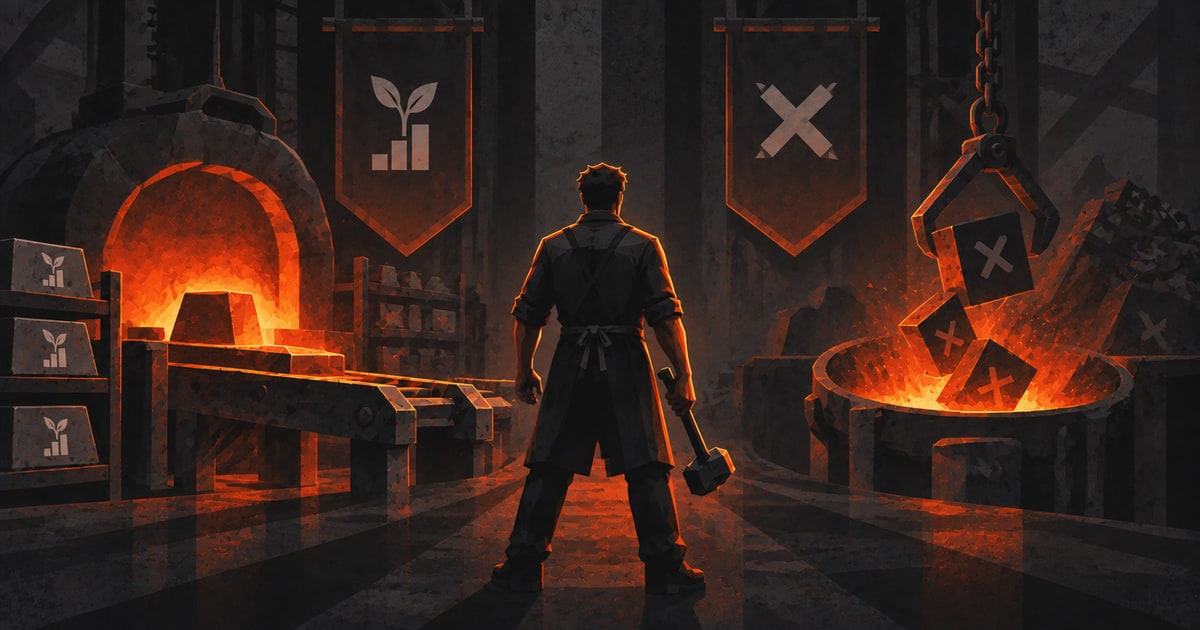
The constraint in a studio of one isn’t ideas. It’s hours.
I have more venture ideas than I’ll ever build, and so does every founder I’ve met. What I don’t have is a second calendar. So the real job, the one no agent does for me, is deciding where the hours go: which venture gets built this week, which one waits, and which one I stop pretending is alive.
This post is the decision rules I actually use, followed by the calls I made this year, all of which you can check against the ventures page.
Four questions before anything gets hours
When an idea shows up, or an existing venture asks for a week, it has to get through four questions. The order matters.
1. Can it reach a first sale with what I already own?
Not “could it be great.” Could it reach a stranger paying, using the stack, the data, and the audience I already have. If the honest answer is “yes, after I build three other things first,” the answer is no, or not yet.
This is the rule that keeps the studio a studio rather than a pile of dependencies. Each new venture should start from the previous ones’ tooling, not from scratch. That’s what the shared platform is for.
2. Will it run without me by its First $10K?
Every venture is designed for my absence from the start, or it isn’t built. I wrote the philosophy of that in Freedom Through Autonomy; the practical version is a question I ask before the first commit. What does this need from me every week once it’s working, and how do I get that number down before I build anything else?
If I can’t picture the answer, the venture will become a job, and I already have one.
3. Does it feed the others?
A dozen ventures on one founder only works if they share. Shared tools, shared data, shared audience. A venture that would need its own separate everything is a venture for a different studio.
4. Would I use it?
The last question is the least strategic and the most reliable. If I wouldn’t use it, I’ll stop caring about it at the first hard week, and a studio of one can’t afford ventures nobody in the building cares about.
Then the tiebreaker
If something clears all four, I apply Derek Sivers’s rule from 2009: “If you’re not saying ‘HELL YEAH!’ about something, say no.” It sounds glib. It isn’t. With one calendar, a lukewarm yes is a no that costs more.
And for sequencing, I lean on Rob Walling’s stair-step method: a simple product with “a simple marketing plan, one that only requires a single traffic channel” first; get it to the point where it pays for your time; then go after the harder, recurring thing. A studio of one is stair-stepping in parallel, which is either efficient or a way to have a dozen things on step one. The status table tells you which.
The status ladder, as a scope tool
Every venture on this site carries a status label, and I use the labels as gates, the same way Make First uses its Firsts. Here’s what each means when I use it:
- In development. Being built. Nothing to show a stranger yet.
- Private alpha. I use it. Nobody else does.
- Prototype. A stranger could try it. I wouldn’t charge for it yet.
- Preview. Public and incomplete, with the gaps visible and feedback invited.
- Private beta. Real users, by invitation, on the way to being supported.
- Live. Anyone can use it, and I stand behind it.
The discipline is that a venture doesn’t get to call itself the next thing up until the evidence exists. That’s not modesty. It’s scope control. “Live” is a promise about support, and I only have so many of those to give.
The calls I made this year
Every one of these is recorded in the site’s own spec, and you can see the result on the pages.
I removed a product from the navigation because it wasn’t live. There was a “Deploy” item in the header pointing at something that didn’t exist yet. It read well. It was a promise I couldn’t keep. It’s gone, and the old address redirects to the platform page.
I removed a venture, then brought it back narrower. eCollective came off the site one day because it didn’t fit the story, and came back the next as an education venture with two things I’d been treating as separate ventures, DIY Degree and Open Degree, folded under it as sub-brands. Changing my mind cost sixteen lines of a data file. Not changing it would have cost two ventures’ worth of attention.
I parked the sub-brand domains that don’t resolve yet. On the ventures page, a sub-brand only gets a link if its site actually answers. The rest are chips without links, and in the data behind the page they’re parked with a dated note. A link checker runs before every release to keep that honest. It’s the least glamorous scope decision in the studio and the one I’d defend hardest: a dead link is a small lie, and the site tells a lot of them if you let it.
I declined to build a rating system for the Stockyard. The directory has ratings on listings, and they’re placeholders set at import. The methodology page says so. I’m not building a real rating method until I can document one that means something, because a number that looks like a review and isn’t one is worse than no number.
I marked two platform tools “coming soon” rather than describing them as done. Forge and Helm. The earlier version of the platform post described both as running in production. They weren’t. Now the site says what’s shipped and what isn’t, and the post says the same.
I kept the Foundry free and didn’t build a paid tier. A paid membership pitch existed in draft. It read well. The Foundry doesn’t have members yet, and charging for a room with nobody in it isn’t a business model, it’s a hope. So the founding cohort is free, and the site says “founding cohort forming” instead of anything grander.
Notice what those have in common. Almost none of them are “build this.” Most are “stop saying that.” A studio of one spends more of its judgment removing claims than adding features, and I think that’s correct.
What “kill” means when you’re alone
Killing a venture in a company is a meeting, a memo, and some hurt feelings. Killing one alone is quieter and, honestly, easier to avoid, which is the danger.
Here’s what it means here:
- Park it with a dated note. The venture’s data entry stays, the status stays honest, and the note says when I stopped and why. Future me will want to know.
- Keep the domain or let it lapse, deliberately. Either is fine. Forgetting to decide is not.
- No sunk cost. The hours are gone whether I continue or not. The only question is whether the next hours are better spent here than elsewhere.
- Say it out loud. The status table is public. If something’s parked, it says so. That’s the whole enforcement mechanism, and it works better than any I had with a team.
I have five ventures in development right now. Some of them will be parked. Deciding which is the most important thing I do in a quarter, and it’s the thing I’d least want to hand to a system.
The zero-to-one judgment
If there’s a single skill underneath all of this, it’s cutting scope until a stranger can use the thing this week.
Not “this quarter.” This week. Every venture I’ve gotten to a real status got there because at some point I stopped adding and asked what the smallest version was that a stranger could touch. Every venture that’s stalled is one where I haven’t asked that question recently enough.
Agents make this harder, not easier, in one specific way: they make building cheap, so the temptation to build one more thing before showing it to anyone is constant. The discipline is the same as it always was. It’s just that the excuse for not shipping got worse.
If you make these calls alone
The founders I want to compare notes with are the ones who make decisions like these with nobody to talk to. If you’ve built a business by yourself and taken it past $100,000 in revenue, you’ve made a hundred of them, and you probably have rules I haven’t thought of.
That’s what The Foundry is for: a small, free, private group of solo founders, comparing notes on exactly this. The founding cohort is forming.
This is the sixth post in the Studio of One series. Previous: The Firsts: Six Gates Between an Idea and a Real Business. The math behind the hours is in One Person Plus Agents.